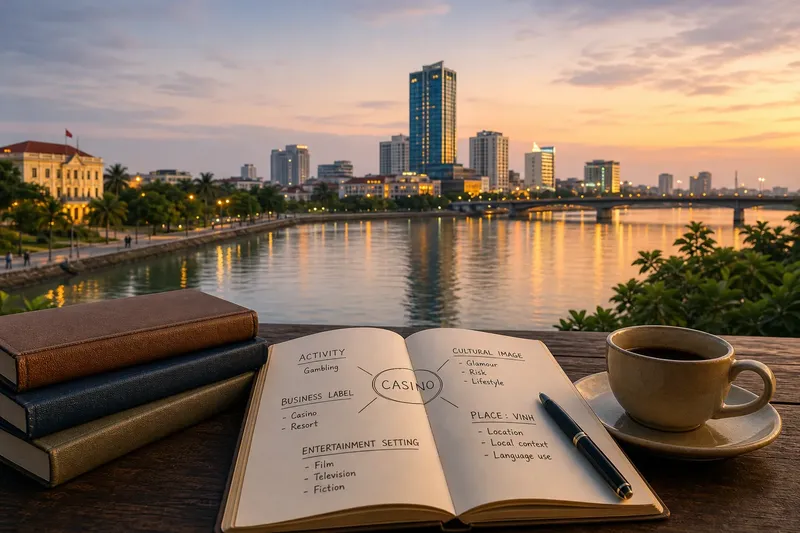
How Vinh’s Casino Image Travels
Vinh casino culture becomes clearer when you trace how casino stories connect local language, public space, and the people who give a place meaning.

What does a casino story actually tell you about Vinh? Vinh casino culture is not just a question of whether a venue exists; it is also a question of how people talk about leisure, public space, and the city’s identity.
A local phrase, a street-side conversation, or a post shared among residents can give a casino a meaning that an outsider’s description misses. The useful task is to notice how language travels between people and settings, without treating one account as the voice of an entire city.
Local meanings
Words such as “casino,” “gaming,” and “entertainment” do not carry identical social meanings. One person may use “casino” for a specific kind of venue, while another may use it loosely for gambling or for a fictional setting. Before interpreting a remark, ask what the speaker means by the term.
Public language can also reveal a tension between private recreation and shared expectations. Someone might discuss gambling as leisure, while another focuses on its consequences for families or neighborhood life. Those positions can coexist; a careful account names the difference instead of flattening it into a single local attitude.
Translation deserves the same care. If a Vietnamese term or venue description matters to the claim, retain the original wording alongside an attributed translation, or consult a qualified translator. A convenient gloss can make a social distinction disappear.
Everyday settings
Place matters because social meaning often depends on where a conversation or activity occurs. A venue, a hotel lobby, a neighborhood shop, and a family gathering are not interchangeable settings, even if a story groups them under the same label.
Be specific about what a source actually locates. “Near Vinh” is not the same as “in Vinh,” and a regional reference does not identify a neighborhood. If the source gives no exact setting, leave that uncertainty in the account rather than filling it with a guess.
It is not worth the effort to infer a city’s social attitudes from a passing slogan or a stray comment with no context. If the remark is incidental and its speaker or setting is unknown, treat it as a fragment, not a civic portrait.
Public conversation
Different speakers bring different interests to casino language. A business description may emphasize hospitality; a resident may talk about noise, access, or routine; a fictional character may use a casino to signal status. Those statements describe their speakers and purposes before they describe a shared public view.
Listen for who gets to speak and who is described from a distance. A story that quotes officials but not residents has a different social texture from one that records several local perspectives. Neither format automatically settles the issue, but the difference changes what conclusions are fair.
Public conversation also has its own limits. A short exchange may be shaped by politeness, privacy, or the moment in which it occurs. Treating silence as agreement is a remarkably efficient way to invent consensus.
What do local terms mean?
Does “casino” always mean the same thing?
No. A source may use the word for a specific venue, a broader gaming activity, or a figurative setting. Check the surrounding description before deciding which meaning applies.
Can one speaker represent local opinion?
One speaker can describe a personal view, not a whole city’s position. Attribute the view to that person and avoid turning it into a claim about residents generally.
How should a translated phrase be handled?
Keep the original term available when its nuance matters, and identify who supplied the translation. If the distinction could change the interpretation, ask a qualified translator or knowledgeable local speaker.
What does a broad location tell you?
A phrase such as “near Vinh” identifies only a broad area unless the source adds more detail. Do not attach the subject to a particular neighborhood or venue without support.
A careful reading
Imagine a reader receives a message describing a casino as “where Vinh’s young people go now.” The message includes one short quotation, gives no location, and offers no link to its original source. The reader first preserves the exact phrase, then asks the sender for the source; no link is available. The resulting account can say that an unattributed message makes a claim about young people, but it cannot identify a venue or establish a broader local pattern. If the discussion requires a grounded example, the reader leaves the claim out and looks for a traceable source that identifies its speaker and setting.
That is not a verdict on the message’s truth. It is a decision about what the available details can support, and it leaves room for local voices without borrowing their authority.
Reading social meaning
To understand Vinh casino culture, attend to the words people use, the settings they refer to, and the interests that shape a public account. Separate a speaker’s own view from claims about a wider community, and keep uncertain translations or locations visible.
The most useful question is often small: who used this term, in what setting, and for what purpose? An answer may not settle what a casino means to Vinh, but it can show whose meaning is being presented—and whose is still missing.